Friday, March 9, 2012

Walter, I Need to Warn You...

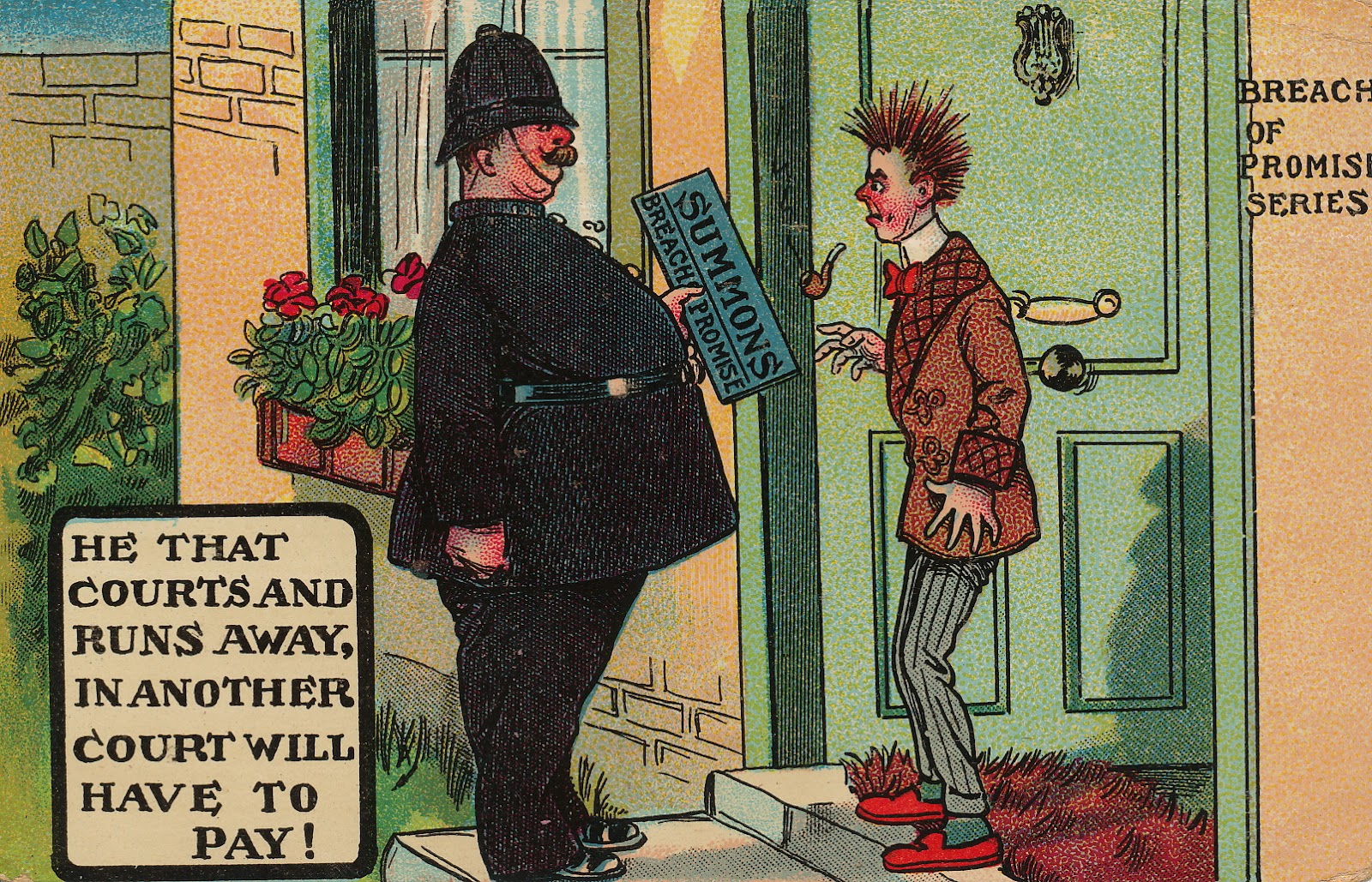
Young Walter Gemmill received these cards in 1907. Based on what I found on the Family History Library and Census records, Walter was born in 1904. Later Census records show him working in a clerical position and then as a purchasing agent in 1930. Walter was three years old when he received these cards. I would like to have added a note on the cards, a word of caution for Walter. It might have saved him a lot of grief.


It seems that at the age of eighteen Walter started working as an office boy for the Milton C. Johnson Company, a New York corporation that printed and supplied stationery for banks. Over the years he worked his way up the corporate ladder to become president.

At some point in about 1960 the company made an investment of three or four million dollars in new equipment. As a result, the company was a little strapped for cash, and Walter started factoring accounts. In other words, as soon as the company submitted bills to its customers, a factoring company would advance Milton. C. Johnson Co. 85% of that amount, so the company could meet payroll. When the customers paid their bills, the factoring company received the full amount, i.e. a 15% fee. However, in October, 1970 the factoring company notified Walter that they would not meet the day's payroll, nor would they do so in the future. They had no contractual obligation, so there's not much Walter or Milton C. Johnson Co. could do.

Walter himself hadn't received a salary in over a month and was owed back wages. He called the employees in and told them the company was out of business and that there was no money to pay their wages.  A lawsuit followed, which held Walter, as an office of the corporation, liable for putting the employees at risk and violating the Labor Law.  I don't know what became of Walter after that, although he died in 1988. It would appear that he never married or had children. It's sad to think that the company was his life. To read the text of the legal case, click here.


Here are the backs of the cards, missing the note that I would have added.


Thursday, March 8, 2012

Buy This Stuff, Or Else!


You'd better get some, because this little guy means business. Don't make him shoot you.

Wednesday, March 7, 2012

Telephone Memo

As we travel around with our cell phones it's hard to imagine what it must have been like to receive only rare phone calls, and always connected by an operator. If you weren't home the phone would just ring and ring until the operator decided the person was not home. I'm not familiar with this kind of phone though. It appears that the speaker and receiver were fixed and you would just stand next to the phone and talk.

It looks like the girls who sent this, Marvel and Mable, pasted their photo over the printed message. They sent the card from Kingston, Missouri to Marnie Howard in Pueblo, Colorado.  I couldn't find much on Marvel, Mable, and Marnie, except that Mable was born in 1900, and her father John was a mail carrier.

Here's the back of the card, with a message that says:
Hello Marnie
Goodby.
Marvel P.

Tuesday, March 6, 2012

Japan, Hozugawa Rapids

If you want to travel in the tracks of the Prince of Romania and the Prince of Wales in the 1920s, as well as a number of other royal visitors, you may want to take a scenic boat trip down the Hozugawa Rapids in Japan. The scenery is supposed to be beautiful. It's a little hard to tell from black and white postcards, but this old hand-painted one is much more colorful. It was in with the other Hozugawa postcards, so I am assuming that it is the same location, but I can't be sure.


I love how they're all wearing hats.


Here are the backs of the cards in the same order.


Monday, March 5, 2012

Norwegian Talking Hands

We are in need of a Norwegian translation here. Anybody out there speak Norwegian? If so, your help would be greatly appreciated. We can see that it has something to do with the language of the hands. I understand one of them to say "I will always be true to you", but I couldn't tell you with any certainty what the rest of them represent. Of course it might be more fun to make up meanings. In that case I will say that the two black-cuffed hands on the right (jeg falder tilfeie) means 'I fold tinfoil.'


In any case it's a wonderful card.  Thanks to my neighbor, Marilee, who graciously lent me this card to post here. Here's the back of the card.

Friday, March 2, 2012

Beware of Free Samples

When someone offers you free samples, this is what they may have in mind. Well, they are pretty cute. O.K., I guess I'll take a couple.


I have seen this 'Nit' on cards before. I seem to recall that it stands for something, but I can't remember what. Does anyone else know? Any guesses?

Also, I have only seen Washington state abbreviated as WA, never as WN.

Here's the back of the card.
The message to Master H.G. Modrell of Tekoa, Washington reads:

Dearest dear:
Why don't you ever write to me? Gee but I would like to have you here now. How are you feeling now? How is your Mama? Well so long and ans soon.Love to u'all. How's my kitty are you taking good care of her for me? 
Lovingly 
Aunt Elsie


Tekoa is a small town in eastern Washington near the Idaho border. It currently has a population of around 800 people, but back in 1912 when this card was sent, the population was closer to 1,500. Cheney, Washington, which is located in Spokane County (also eastern Washington) had a similarly-sized population in 1912, but their population has continued to grow and is now over 10,000.

Thursday, March 1, 2012

What Were They Thinking?

If you had been a fly on the wall, this is the conversation you might have overheard:

Museum Director: We really need to do something to attract more visitors to the Harry S. Truman Library and Museum.
Marketing Director: Well, perhaps we should print a postcard.
Museum Director: Great idea, but which exhibit should we feature? There are so many good ones to choose from.
Marketing Director: Well, we could feature a photo of the atomic bomb along with a catchy slogan.
Museum Director: Or something about the Cold War or Israel...
Marketing Director: Maybe we should go with something less controversial.


As you can see, the results were very good. The eye is drawn to numerous points of interest: flags, lectern, electrical outlet, presidential seal, heating vent, wide expanse of wall, metal windows with photos attached to the glass. You can't go wrong.

And then there's this memorable postcard. I don't know. Am I missing something? Who would send this? And who would they send it to?


Here are the backs of the postcards.


Wednesday, February 29, 2012

Take the Leap!

Did you notice that we have one extra day this month? Leap year is better news for people who are paid by the hour than for people who are on a monthly salary, so it all depends on your perspective whether you appreciate it or not. Here's a card from some previous leap year, circa 1920.


Initially I was puzzled by this card because I didn't make the connection between leap year and 'taking the leap', i.e. getting married. I can't say I've heard the expression used in conversation. More often it's something about tying the knot or making an honest man/woman out of someone. In the early 1900s there were plenty of humorous postcards that pointed out the perils of marriage and courtship, mostly, though not always, presented from a man's perspective.


This one's a little odd, isn't it?


And this one's pretty unusual too.


Here's the back of that last card, sent in 1909 to Miss Verlene Hall in Sargent, Nebraska. You didn't think the card was that old, did you?


The message reads:

Made good connections in Joe 8:45 there is little difference in weather conditions here and there. The weather is gloomy and so ___ _. ha: he, he!
I am mad at that hello girl because she wouldn't let me say all my say. 
X---

I think 'Hello Girls' were telephone operators.

Monday, February 27, 2012

Tram Tuesday - Attleboro, Massachusetts

There was grass growing in the middle of Park Street in Attleboro circa 1907. It was a big wide street with lots of space separating the sidewalk and the streetcar tracks.


It doesn't quite look like that anymore. Here's a more modern view.

View Larger Map

Frank B. Eldredge sent this card to Jose Galavisi in Buenos Aires Argentina in 1907. Frank was a little perturbed. It seems he had sent Jose some American stamps in anticipation of an exchange, but Jose had simply returned the stamps.

The message reads:


Your letter with enclosures received 
am sorry you returned the sheet  of common stamps I hoped you would have sent  me a sheet of common Argentine stamps in return or handed it to someone who would. I should like a list of what you desire in USA stamps and also would ask what catalogue you use for medium of exchange. Upon receipt of list from you I will send you what I wish in Argentine stamps provided your list contains stamps I can furnish.


Giant Peaches

No need to worry about those peaches rolling off the flatcar; note the carefully positioned braces.


Rosella sent this card in 1912 to her sister, Mrs. Ina Clark, in Eureka, California.

The message reads:

Dear sister:-
Mamma received your Birthday postals . We are waiting for you to come home and see us. Uncle Hans'  and Uncle Amos' came up in the automobile on mama's birthday. How is Mrs. Crothers? We are all well and hope you are the same. Best regards from Raymond and all. 
Rosella.    write soon

Friday, February 24, 2012

Shoes in the 1880s

I was looking for some old family photographs with shoes for this week's Sepia Saturday and came up empty handed. Nearly every photo seems to cut off the feet and shoes. For all I know they sat for portraits with no shoes on at all. I do have some very nice shoe advertisements from the 1880s though. One of my favorites is the trade card featuring solar tip shoes.


I somehow had this idea that solar tip shoes would be open in the front, allowing the sun to warm your toes. Not so. Instead, they were especially durable tips made by folding the sole leather over the tip of the shoe.

This is one of the few trade cards for shoes that highlights the shoes at all. Many of the advertisements simply showed heartwarming scenes that had nothing to do with shoes, like this one:


And this one:


Many just had their business name printed on stock advertising cards. These could just as well have been ads for a grocery store or watch repair.


So, I had to wonder what the shoes of the 1880s were really like. I know that women's shoes had a high heel and a narrow toe and didn't look comfortable at all. On the other hand, when I went to the Wisconsin Historical Museum's online collection to look at the examples of children's footwear of the era, they not only seem well made, they look soft and comfortable. You can see the shoe collection here.

Step on over to Sepia Saturday to see more posts on shoes.

Thursday, February 23, 2012

Dear Brother Walter...

One of the most popular posts on this blog, for reasons totally unknown to me, is another card sent to Walter Till.  I'm perplexed by its popularity, because I just don't understand it.

Anyway, on to brother Walter.  The birthday card that is viewed so often for unknown reasons, is from 1916. This one is from 1919.


It's a lovely card, but it wouldn't be my first choice for a 9-year-old boy.  The message on the back of the card reads:

5/2/19
Dear Brother Walter
I came near forgetting when your birthday was but dident. here is just a card hoping you have a happy one suppose you will be 9 years old Sun. you want to see how good a boy you can be from now on let Jesus help you
Love from Sister Laura


It started to seem more likely to me, after looking at previous cards, that "brother" was meant in a religious sense, but then I found that Walter actually did have an older sister named Laura. In fact, he had 10 siblings. The 1920 Census shows Walter, the youngest at age 9, living with his siblings, George (11), Edna (13), and Jennie (15) and their mother Julia E. Till. There is no indication of a father in the household, because the father died a few months after Walter's 9th birthday. Walter also had a younger brother who only lived to the age of four.

I looked for more information on Ancestry.com and was surprised to find photos of Walter and his siblings. There's our little Walter on the right.

And there's Jennie on the left. Here's a postcard addressed to Jennie.


The message on the back reads:

Dear Jennie: -
Come up and see the School house fore your self. my room is where the X is. I wish you a happy easter. your friend Bertha.

Wednesday, February 22, 2012

Train Disaster at Wellington

This doesn't look like a train disaster card, does it? It's a perfect example of a relatively plain card with a very poignant message. It hardly matters what's on the front. I was looking for cards to post for St. Patrick's Day when I came upon this one. The news is not very cheerful, so I thought I'd post it on a day other than the holiday.


Grace sent this card from Seattle to Miss Sara Clark in Dexter, New York on March 10, 1910.
The message reads:

Dear friend, - You had all better come west here to live. Although we have had a very bad winter. Suppose you have read of that awful avalanche on the Great Northern. It seems terrible here, for we are so close. They are bringing many of the bodies here. Love to all,
Grace.


It reminded me of the tragic Washington avalanche this last weekend that killed three skiers at Stevens Pass. The 1910 avalanche was also near Stevens Pass, but was much more severe and much deadlier. It swept away two Northern Pacific trains and claimed the lives of 96 victims. You can read more about the disaster at HistoryLink. You may also want to look at the Wellington Avalanche website.

Afterwards, the small railroad town of Wellington changed its name to Tye (after the Tye river) because of the negative association with the disaster. Tye became a ghost town after the second Cascade tunnel was opened in 1929.

Here's a photo of the aftermath of the avalanche, with blanket-wrapped bodies being prepared for transport. The photo is courtesy of Paul Dorpat, a historian who writes for the Seattle Times Sunday Magazine and has a superb website.

Source

Tuesday, February 21, 2012

Tram Tuesday - Honolulu, Hawaii

Although we don't know the exact date of the postcard, the publisher (Wall, Nichols & Co.) stopped production in 1912, so I suspect the card is from sometime between 1907 and 1912.

The signs on top of the car show Fort Street and Punahou on the front and Kalihi and Waikiki on the back. The initials on the front of the car stand for Hawaii Rapid Transit & Land Company, a company founded in 1898, which developed electric streetcar service in Honolulu. The streetcars ran at 10-minute intervals and helped to popularize Waikiki.


This was not the first streetcar service though. Hawaiian Tramways Limited had previously provided mule-drawn streetcars, starting in the 1880s. By 1942, the streetcar system had been completely replaced by buses.

Most cities the size of Honolulu currently have some sort of streetcar or light rail system. Honolulu doesn't, but it has plans for an elevated transit line, a proposal that has been fiercely debated for years. Honolulu just received approval from the Federal Transit Administration to commence construction, but opponents are suing to stop the project.

Here's the back of the card.

LinkWithin

Related Posts with Thumbnails