Monday, March 26, 2012

Williamsburg Bridge - New York City

The Williamsburg Bridge crosses the East River, connecting the Lower East Side of Manhattan with the Williamsburg neighborhood in Brooklyn. When it was built in 1903, it was the longest suspension bridge on earth.

There was great fanfare when the bridge opened and it was all caught on film.


Here's the back of the card.

Friday, March 23, 2012

Missing Ingredient

The 'Young Men Wanted' sign in the background is probably a coincidence, but these ladies might indeed enjoy the company of some young men for  a fun night on the town.


This lady's a little more direct.


 Here are the backs of the cards in the same order.

The theme for Sepia Saturday this week is 'going out.' To participate or to just have a look, click on the picture below.

Thursday, March 22, 2012

A Balanced Diet

A balanced diet includes several servings of fruit per day. Help yourself.


Neither of these cards was sent. The backs both look like this.

Wednesday, March 21, 2012

My Old Kentucky Home

The story goes that Stephen Collins Foster was visiting the former home of his cousin, Judge Rowan, in Bardstown, Kentucky in the 1850s and was inspired to write the lyrics to the song, My Old Kentucky Home. That story is now thought to be apocryphal, but it doesn't matter because by then Judge Rowan's house had been declared a State shrine, and the song was designated the official state song of Kentucky.

Here's the original song:

By 1986, Kentucky had a black legislator, Carl Hines, who objected to the word 'darky' and successfully sponsored a bill to change the word to 'people."

I looked at this card and imagined Foster sitting by the rustic hearth composing the lyrics.


I guess I was reading the caption on this card too literally, because then I saw this postcard and had to revise my image to a better-dressed Stephen Collins, sitting in the elegant parlor and sipping a mint julep while he wrote the lyrics. Whatever the case, the song is also the official song of the Kentucky Derby and is played at college football and basketball game in Kentucky. It's part of the state's heritage.

I have many cards that show the exterior of Judge Rowan's house. Here's one of them.


And here's the back of the first card, sent to Leona Cowles in Olympia, Washington. The message reads:
Thanks a lot for the nice card. I do hope you like this one. Yes I will be glad to have a greeting card from Seattle or San Francisco as I do not have any for either place. But I do have one from Pittsburgh PA. Please come again.
Norman Inman 719 Ashland Ave Louisville Ky

Tuesday, March 20, 2012

Tram Tuesday - San Francisco at Night

Looking at this postcard, you might think this is a cable car rather than a streetcar, but it's hard to tell since any overhead wires are invisible. It's even hard to read the printing at the top: Market Street and Palace Hotel at Night. San Francisco, California. 

There were cable cars on Market Street until the 1906 earthquake and fire; after that, there were streetcars. This card was sent in 1912, and the picture shows the new Palace Hotel, built in 1909. The original 1887 Palace Hotel was destroyed by a fire following the earthquake. That means these would be the new trolley cars not cable cars.

This reminds me of that wonderful film footage of a trip down Market Street on a cable car, just days before the earthquake. In case you haven't seen it, it's a great ride.


And here are some pictures of the original Palace Hotel and the new Palace Hotel.


Here's the back of the first card, sent to Jack Keegan in Portland, Oregon.:


Frisco 11/3 -12

Dear Jack
Regards to you and yours from me and mine. Best remembrances to "Chubby" and rest of bunch. always be sure your eggs are hard boiled. Tell C. Johnson that the D. & R. G. have grand offices in Frisco. The cubs (?) at Garibaldi Hall were asking for you
TIP

(Note: I think the D. & R. G. refers to the Denver & Rio Grande Railroad)

Monday, March 19, 2012

My Son Karl

I don't speak Norwegian, but I think I was able to get the basic meaning of the text, based on similarities with other languages -  and a lot of guessing. But then again, I could be wrong. If you speak Norwegian, please feel free to make any corrections.

At first I thought this was a mass produced postcard, but it looks as if it is actually a real-photo card of a family member. Here's the back of the card, sent from Fredrikshald (now Halden), Norway. I have to give the post office special credit for recognizing Kallifonia, and for finding the new address of the recipient.

The message on the back of the card seems to be wishing Johan a happy Christmas, though by the time he receives the card the holiday has already passed.  It looks as if the card was sent on the 7th of December, 1911 and didn't arrive at its destination until a month later.

The message wishes Johan a happy Christmas and appears to be from his sister, Alma Hansen, who says "Here you see my son Karl."

Saturday, March 17, 2012

Happy St. Patrick's Day

St. Patrick's Day cards are a thing of the past, though we still celebrate the holiday.


These are both embossed cards, something that you can't really see on the scans, but it creates an uneven writing surface on the back and can make for illegible messages.

The message to Miss Georgie Green in Wayland, New York reads:

"Hello Georgie"
How you was over thare. All well I hope. You probably think I am an awful lyer but I am but I am sure  coming over It has been impossible for me to come before.
ans soon W.S.


This one, to Mrs. B.G. Brown of Norwich, New York is a lot harder to read.

Dear Ella and Bige I joust see your letter you wrote to day found it in Mells pocket - I hope you are both well and will have a nice day to day. Gladys and Bob are  up to Nellie's now Poor Nellie she has her hands full I can tell you and as does May we have moved the central (?)  agen. I bought a place think it would be cheaper  than to rent - come up  you and Bige would like to see you. Ma is well and looks well love, your mother

Friday, March 16, 2012

There Are Clues

There are clues here. I know there are clues that would help identify the location, the time frame, and a number of other details. The problem is that you have to be able to recognize the clues.

Here's what I come up with. The man on the left is Native American; I say that because he appears to be wearing moccasins rather than shoes.  The photograph was taken sometime before 1907, because the back of the card is undivided, meaning that there is only space for an address (no message) on the back. The stamp box design indicates that this real-photo card was probably developed on Eastman Kodak paper circa 1904.

Based on the dress of the man on the right, I would say we are in the western part of the United States, but how far west? I really couldn't say. There are more unanswered questions. What is that box on the wall? Who are these people? What is the pole that the Native American man has across his lap? Although the (presumably) Native American man seems humble and unassuming, the other man's attention is focused entirely on him. Was he someone important? I like to think that he was the Kalispel Chief, Masselow, based on some physical similarities, but who knows. Here's a picture of Chief Masselow from the First People's website. I'm sorry that I can't solve the puzzle of this card, even though I enjoy the mystery. Still, I can't help but think that in the right hands, these questions would find answers. Feel free to add any suggestions or insight you may have.

Here's another lead. Notice that the Native American man has a little bit of facial hair. Contrary to popular belief, Native American, particularly those in the Pacific Northwest, did grow facial hair. The facial hair may help to narrow down the tribe of this individual, because it was certainly not typical of all Native Americans. I think it probably narrows it down to the Pacific  Northwest Indians. This Edward Curtis photo from the Library of Congress shows a Native American (Old Bob from the Karok tribe) with similar facial hair.

Source: http://hdl.loc.gov/loc.pnp/cph.3c18587

Here are a couple of close-ups of the men. The resolution of the original is not great, so this is as good as it gets.


The theme for Sepia Saturday this week is scouts. My post has nothing to do with scouts, except for  'scouting for clues'. If you want to see some real scouts, march on over to Sepia Saturday.

Thursday, March 15, 2012

What is it about those Mainers?

I've just been reading through an amusing little book of Maine postcards from 1900-1920. The book was compiled by Deborah H. Gould and is entitled: Father is Here...He's as Fat as a Pig. Believe it or not, the title comes from a message on the back of one of the cards.

 
Some of the fronts of the postcards are featured in the book too, but the real focus is on the messages.  The book is tiny, barely larger than a postcard itself, but it is full of great messages:

Monday Morning I am feeling fine expect to get a new leg today.

Everything went fine, except the fire...

Do you remember the fat man we saw out here Aug 2

Sister I did not go to the fair after all. Jimmy brought home some real bananas kinder think he'll die before morning.

I have looked at a lot of postcards and I also tend to focus on the message side, but I have never seen so many unusual, cryptic, and hilarious messages on postcards. I wondered how Deborah was able to find these. She must have spent years going through boxes in antique stores and flea markets.

I also wondered if the unusual nature of the messages had something to do with the fact that they are all from Maine.  I have a number of Maine postcards. Here are a few.


Very few of my Maine postcards have any message at all on the back, including the ones that were sent. None of these do, not even the last one, sent in 1925 to Miss Elizabeth Hall on Great Diamond Isle in Portland, Maine. No message, not even a signature. I know that Mainers have a reputation for saying very little, so I assumed that this might account for the lack of messages.

Maybe the cards with the great messages never make it out of the state. I don't know. I noticed something else about the messages in the book though. Fat is mentioned in a number of the messages, something I found very unusual. I have also never seen haint written on a card, as in Dear Sister I haint heard from you for some time... I think it was a good idea to limit the cards in the book to Maine cards, because you get a sense of the place as well as the era.

If you want to take a closer look at the book or order one for yourself, you can find it here on Amazon.com.

Wednesday, March 14, 2012

More Motels For You

If you're still not sure where you might like to go this summer, here are a few more suggestions.
I recommend the Downtowner Motel in Memphis, Tennessee for the consistent and classic decorating scheme with warm hues carried throughout, and effective lighting and a appropriately-sized painting on the wall. Smokers will be glad to see that the room is well supplied with ashtrays. Sorry, no wi-fi.


The Floritona in Daytona Beach claims to be on the world's most famous beach, so why are people sunbathing in the grass with a view of the parking lot (even if they are nice cars)? I don't know, but it might be worth it for you to go there and find out.

These two motels, in Sharpsburg, North Carolina and Ashland, Virginia, seem similar enough to be interchangeable. It may just depend on whether you prefer yellow or pink bedspreads.

Here are the backs of the first two cards.

Tuesday, March 13, 2012

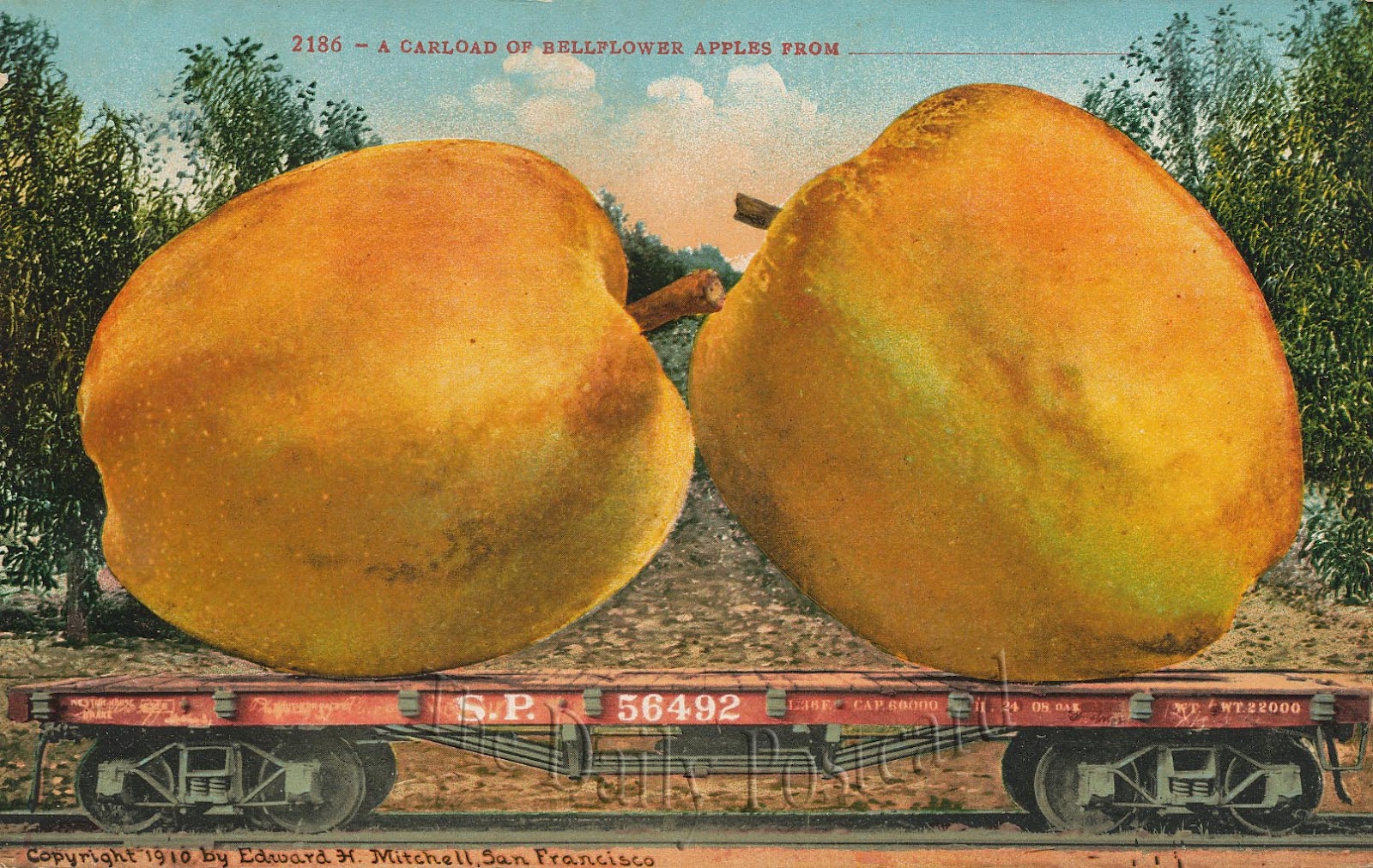
Bellflower Apples

These aren't just any giant apples; they're giant Bellflower apples.


If you happen to be in Portland, Oregon, you can go to see the oldest living grafted apple tree in the state, a Bellflower planted in 1850. It was bought from Luelling and Meek Nursery in Milwaukie, Oregon, the first grafted fruit tree nursery on the West Coast.  The tree is about 36 feet tall and has a 9-foot circumference. It's located at 4700 SW Campbell Court. You can read more about Bellflower apples and their history here.

Here are some more Oregon apples from 1910. Unfortunately, we can't see what varieties they were.


And here are the backs of the cards in the same order.

This one was sent to Master John Ockfen of McKenna, Washington.

Monday, March 12, 2012

Roseburg, Oregon - The Althaus Family

Herman and Eva Althaus moved their family across country from Illinois to settle in Roseburg, Oregon in about 1909. Herman had a plumbing shop.
Here's a photo labeled Louise Althaus, Roseburg Oregon. Every time I look at this picture and the cinched in waist, I feel like I need to take a deep breath.


The next card was sent to Mrs. Herman Althaus (Eva) in 1912. It's one of the most heavily textured cards I've ever encountered, although it's hard to tell on a digital scan.

The last card was also sent to Mrs. Eva Althaus from her niece in Illinois.


Here's the back of the last card, with a message expressing sadness that the family had moved to Oregon. Bertha talks about Herman and Minnie, Eva's son and daughter-in-law:

Belleville, Ills. December 29/09
Dear Aunt I received the pretty card, thank you very much for it. I am looking for a letter right along. I got one of Herman and Minnie's pictures for which I was very very glad, but also felt so sad when I seen them to think that we might never get to see each other any more. I thought sure  I would get a family picture from you before this time. Write soon from Bertha


Here's the back of the second card. These messages make you realize how much more difficult it was to make a cross-country trip in the early 20th century. This one reads:

Dear Sister
I wish you many happy returns of the day and am only sorry that we cannot be together + celebrate
Your Sister Louise S. _____
10-7-12


Last of all, the back of the first card.

LinkWithin

Related Posts with Thumbnails