Friday, April 20, 2012

Gardens

The theme for Sepia Saturday this week is gardens. I have many boring postcards of gardens. That's because it's very difficult to capture the essence of a garden in a small photo, especially a grainy black-and-white photo that then has fake colors added. I do like to look at those old cards of people on promenade through elegant gardens though. You get a sense of the social significance of gardens. They were places to play and socialize as well as places for quiet contemplation.

View from the other side

And then there are the family photos in gardens, a chance for a more casual portrait than might otherwise be acceptable. Here are some photos of my ancestors in their garden in Berlin at the turn of the century. When the city of Berlin was divided into two parts after World War II, this fell on the east German side and my family lost this property. Today there is an apartment building on the site. In the picture below, my great grandmother sits in the chair in front, while my great-great grandmother is on the very left.


Another photo (circa 1906)  shows what appears to be a greenhouse, with my great-great grandmother on the left and my great grandmother in the middle. The smiling young boy is my grandfather. He died during World War II, so I never had the chance to meet him. His sister Käthe is on the right.


And then there's this odd photo postcard, not in very good condition, showing my grandfather, the youngest, and his siblings.


Here in Oregon, we love our garden, especially during the warmer months when we can cook and eat outside. We look forward to that season with much anticipation during the rainy winter months. The benefit of all those rainy months is that everything grows vigorously here.


Even things you may not want to grow vigorously. For more on this plant, visit this previous post.


For a veritable worldwide garden tour, head over to Sepia Saturday.


Thursday, April 19, 2012

Jackson Square - Oak Ridge, Tennessee

At first glance, this looks like one of those incredibly boring cards of a parking lot, but there's actually more to it. This isn't just any parking lot.


Before 1942, the area around Black Oak Ridge was a peaceful rural farming area. It only became a city when the U.S. Government chose it as the production site for the Manhattan Project and the development of the atomic bomb. Although the area was not densely populated, the people who did live there were evicted from their homes and given as little as two weeks to evacuate.

A large number of people were needed to work on the military project, so a town was built for the workforce and their families. Jackson Square was the original commercial site of Oak Ridge, and was surrounded by housing. By 1945, the population swelled to 75,000. The town included 300 miles of roads, ten schools, seven theaters, 17 restaurants, and 13 supermarkets.

It was only after the atomic bomb was dropped on Hiroshima, Japan in 1945 that many of the workers realized what they had been working on. Oak Ridge is no longer a military town, and only has a population of about 27,000. Efforts are currently underway to revitalize and preserve Jackson Square.

Here's the back of the card, sent to Mrs. Addie Wolcott in Miami, Florida in 1955.
The message reads:

Dear Addie: I received your letter but have little time to write these days. The children are very good, but do need a lot of attention. It keeps us both busy. Do hope the hurricanes keep on passing us by.
Love,
Mildred


Wednesday, April 18, 2012

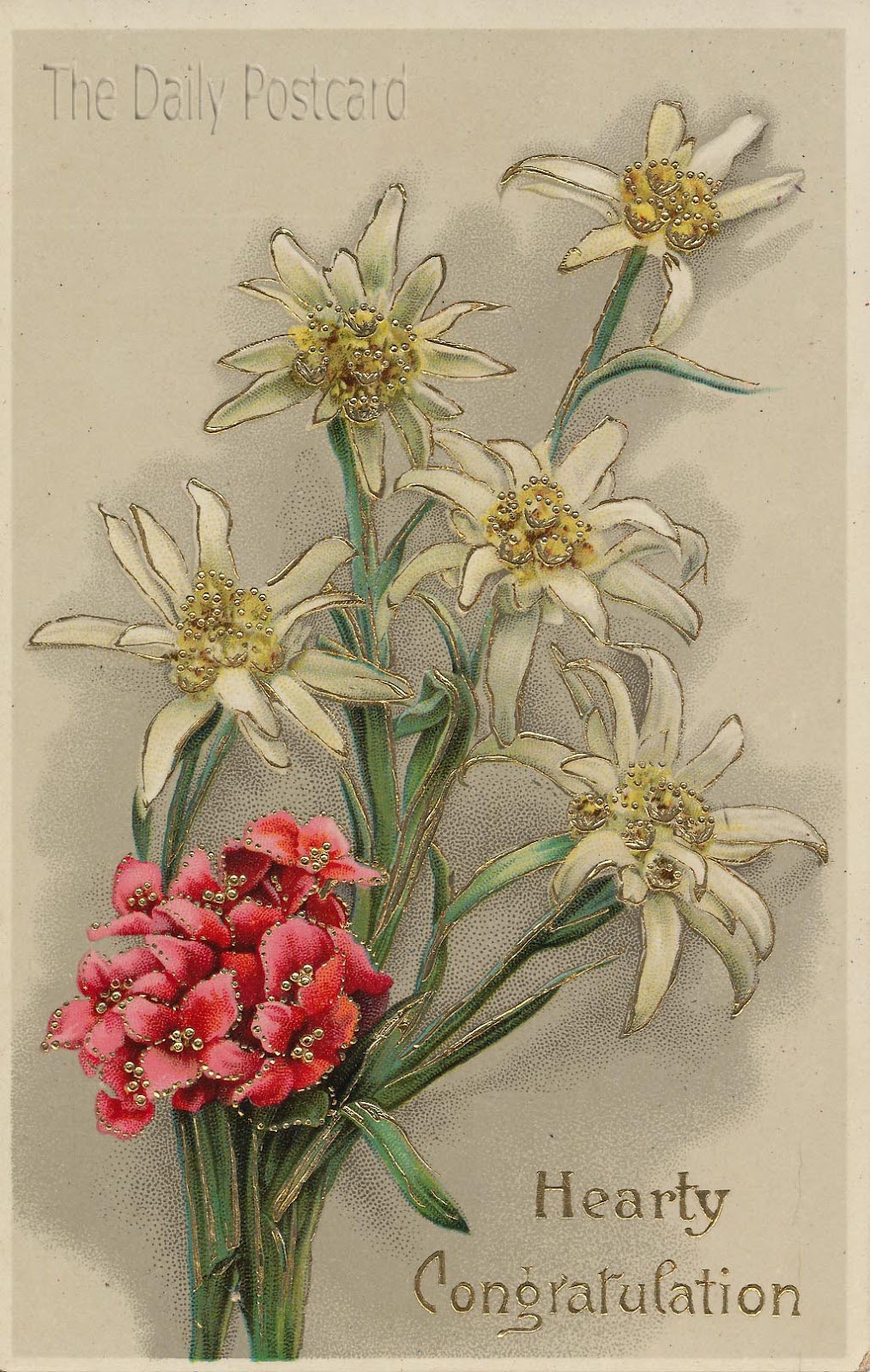
Birthday Congratulation

That's right - only one congratulation. We don't want to give in to excess after all.

Most of the birthday cards I have seen feature roses if they have any flowers at all. These two cards both have pictures of Edelweiss. That's very unusual. The first card was printed in Germany and the second one may have been too, which might explain why there's Edelweiss.

Here are the backs of the cards in the same order. The first one was sent to Miss mabel Every in Bloomville, New York in 1914.


The second one, to Miss May Carey of Tunkhannock, New York, may have been sent in an envelope. The message reads:

If you do not come on diamond and come on local why phone me from station and I will come and meet you.
Norman

Just in case you thought Diamond was the name of May's horse, it was actually the Black Diamond,  a passenger train that ran between New York City and Buffalo from 1896 to until 1959.


Tuesday, April 17, 2012

Tram Tuesday - More from the Côte d'Azur

What I would give to be able to travel back in time and ride on the French Riviera's tram system through Nice, Monte Carlo and surrounding towns! Here are two views of the trams emerging out of tunnels. The contrast of the tunnels, the sweeping ocean views, and the rugged coastline must have been breathtaking.


Here are the backs of the cards in the same order. The second one was written in German and sent to someone in Kaltenhausen, Germany. If someone can decipher that wicked Suetterlin writing, please let me know.


Come back next week for some spectacular views of trams in Le Cannet.

Monday, April 16, 2012

Abraham Lincoln Assasination

Even though his presidency was cut short, the United States would likely be a very different place today if Abraham Lincoln had not been president. On April 14th, 1865, Abraham Lincoln was shot by John Wilkes Booth as the President was watching a performance of play called Our American Cousin. Lincoln died early the next day.  Although Lincoln was unaware of a specific danger on this evening, he had received threats and was aware that his life was in danger.

This is a view of the theater where it happened. The car and its passengers seem to have been added to embellish a postcard that might otherwise have been regarded as stark and boring.


This postcard that shows the Lincoln residence in Springfield, Illinois on the day of his funeral. Lincoln's body was brought by train from Washington D.C. to Springfield, Illinois with several stops along the way where he lay in state. The train arrived in Springfield on May 3, 1865. This was the first national commemoration of a president's death by rail.


It was just a few weeks earlier that Lincoln went to meet General Grant in Virginia to discuss the final stages of the Civil War. General Grant and his wife might well have accompanied the President to the performance that fateful night if Mrs. Grant had not insisted on leaving that evening to visit their children in New Jersey.


And here are the backs of the cards in the same order.


 The text of the card, sent to Mrs. Pharis Luckey of Cromwell, Indiana, reads:

Goshen, Ind.
3-26-14
Dear Ma:-
Aunt Sue had to have the Dr. come to the house for Grandma this morning she has congestnig of the lungs. he thinks she will be all right in a short time but Ma she is pretty sick - sicker than she lets us know so if you want to come down you can.
Minnie

Tell Jim

Friday, April 13, 2012

Wingspread

Lazy blogger that I am, I have enlisted my resident architect to provide us with text for this post. He is after all the expert. We are just back from a trip to Wisconsin where we visited Frank Lloyd Wright's Wingspread and a number of other Frank Lloyd Wright houses.


Here's Wingspread from above. We were given an in-depth private tour of Wingspread and left to wander around and take pictures for as long as we wanted.


Here's what the architect who steals my covers has to say about it:

Frank Lloyd Wright was definitely flying high in 1937 when he designed Wingspread, the +/- 14,000 SF home for Herbert Johnson, president of S.C. Johnson & Son.  Only a few years earlier, Wright was largely forgotten by the architecture world - some even thought he had died - his commissions having dried up after the 1915-1923 Imperial Hotel project (see earlier post), the result of personal scandals and society’s tastemakers rejecting the Prairie Style that Wright had championed starting in 1893.


One project had given life to the second great phase of Wright’s career, Fallingwater, the iconic 1935 country house that catapulted him to the cover of Life magazine and world-wide fame.  Over the next two years, he would create the first Usonian house (the Jacob’s residence), his own incredible desert home and studio at Taliesin West, and the stunning headquarters for Johnson Wax in Racine, Wisconsin.  The next 20 years were the most prolific period of his career, with more than 200 of Wright’s designs constructed.

During the construction of the headquarters, Johnson hired Wright to design him a new home on a large tract of land north of Racine.  A ‘zoned’ plan, four wings containing different private functions- master suite, children’s bedrooms, guest bedrooms/garage, and kitchen/service- extend into the landscape from a central 3-story great hall with living, dining, library and music areas spiraling around a chimney mass with five fireplaces.   
Wingspread - Great Hall

Wingspread - Great Hall

While the name Wingspread was derived from this layout, the glass cupola of the house also provided a location for the Johnson children to watch their father do fly-bys piloting his private plane. 

View from cupola
Spiral stairs to cupola

Many of Wright’s projects had wing-like roof or balcony projections seeming to defy gravity, but The Spring Green restaurant actually used steel trusses from the flight deck of a decommissioned aircraft carrier to allow the building to span a small ravine.  It is currently used as the visitor’s center for Wright’s original Wisconsin home, Taliesin, located nearby.    
Spring Green
Fly on over to Sepia Saturday to look at more views on flight.

Thursday, April 12, 2012

Malta Butterfly

The Republic of Malta occupies a very strategic location in the Mediterranean at the tip of the boot of Italy. Over the centuries, it was under the rule of Phoenicians, Greeks, Romans, Arabs, Normans, Aragonese, Hapsburg Spain, Knights of St. John, French, and finally British. Malta declared its independence from British rule in 1964.


Malta's official languages are Maltese and English, but this card's greeting is in Italian and seems to say something along the lines of : From the beautiful flight I send you greetings.

Here's the back of the card with a message in English.

Wednesday, April 11, 2012

Villefranche-sur-Mer, France

Yesterday's Tram Tuesday post featured Villefranche-sur-Mer, so I thought I'd show some additional views of the city. Apart from being a tourist destination on the French Riviera, Villefranche-sur-Mer has been important as a port for military ships as well as cruise lines, since the it is one of the deepest natural harbors in the Mediterranean. If you want to visit Villefranche-sur-Mer, you can still book a room at the Welcome Hotel, shown on the first two cards.


The Rue Obscure, which was built in the 13th century as a refuge against attacks, still looks the same today.


Here's the port with military ships.


Here are the backs of the first two cards.


Tuesday, April 10, 2012

Tram Tuesday - Villefranche sur Mer, France

The tram line serving Villefranche was part of the TNL line that connected Nice and other scenic locations along the French Riviera. From Nice it would travel to Villefranche and Beaulieau before continuing on to Cap Rouz, Eze, Cap d'Ail, and finally the Principality of Monaco. As you might expect, the route was primarily designed to transport tourists. What a great trip that must have been. Here are some views of the tram as it made its way through Villefranche.


And here are the backs of the cards in the same order.


This is the third part of a five-week series on the trams of the Côte d'Azur. Check back next Tuesday for part four.

Monday, April 9, 2012

National Library Week

Celebrate National Library Week (April 8-14th) by visiting your local library.
If you live in Rome, New York, you can go to the Jervis Library, built in 1895.


If you live in Norwich, New York you can go to the Guernsey Memorial Library, although the building shown here was demolished in the 1967. The new library looks pretty nice too.


You can also go visit the mammoth Milwaukee Library.


Here are the backs of the cards in the same order. I think they're all clear enough to read as is.


 The first card was sent to Miss Persis Davis in Los Angeles. The second one was sent to Alma Tarbox in Harford Mills, new York. I have quite a few cards to and from the Tarbox family.


The last one was sent to Mr. C.P. Robb in Winona, Minnesota.


LinkWithin

Related Posts with Thumbnails