Friday, August 10, 2012

Dr. René Bine

There is so much to say about Dr. René Bine that I hardly know where to start. Someone should make a movie about him. I only learned of him when my reluctant husband accompanied me to a postcard show a year or two ago and started perusing the boxes of 25-cent cards. He was intrigued by these cards with the writing on the front, something generally considered undesirable among postcard collectors.

He purchased a number of cards that day. When we got home I started reading the cards and realized that the messages often continued mid-sentence from one numbered card to the next. It was maddening. I contacted the seller and tried to get the rest of the cards. Alas, there are still some gaps, but with the 80 or so cards and the other records he left, we have  good indication of the man he was.

Here is some of what we know:

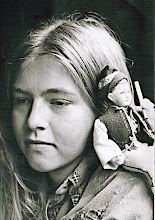
René Bine was born in June, 1882. His father, Leon Bine, immigrated to San Francisco from France and became a U.S. citizen. I am guessing that the elder Bine was a doctor and that his son followed in his footsteps. Young René was a medical student at University of California, Berkeley, where he is shown here as an intern in a  yearbook photo, center right.


By 1904, René was in Europe studying at various European medical schools.  The postcards at this point are already numbered over a hundred, so who knows what we are missing.

The cards are all addressed to his sister, Marie, in San Francisco, but seem to be intended for his parents too.

On October 1, 1904, René was studying at the Medical University in Vienna and  sent this card (#106) to his family in San Francisco.


The message reads:

Oct. 1 -1904
Dear folks,
To-day for the first time since our arrival in Vienna, has the sun shone upon us + after a week of rainy, sloppy weather it is very welcome. Cold persists, but with heavier underwear purchased a block or so further up this street, my overcoat is relegated to the place I've usually accorded it. We expect to see more of Vienna now that we  can walk without wading, as till now we have with a few exceptions confined ourselves to our own neighborhood in which the Krankenhaus (hospital) + other buildings are situated and an occasional constitutional further on to the Ring. The Ring is the street...

I don't find card # 107, but here is #108. 

 The message reads: 

...burg, man not as advertised as others we know, but we shall stay with him until we reach one named Schmidt. Jellinek's friend Kovack is out of reach. From 6 to 7 I will be taking a German lesson from Fraulein Voigt, who gave Dr. Moffitt (Herbert Charles Moffitt - See link) daily lessons for three months on his visit here -with my Grammar absent + my vocabulary small, my conversational abilities therefore shaky when I'm up against a genuine Deutsch wordstringer + I cannot stand for that. From 8:15 to 9:45 we have a practice course on surgical anatomy from Prof.  Julius Tandler (see link about Julius Tandler) 4 times a week only. I also...

And here's card #109

 The message continues from the previous card:

am trying to read medicine 3 times a week no less _____ is in great demand, with Dr Kiehopt (Kuhopt?) who also had Dr. Moffitt's company for a period of 9 months. Paul has arranged for a course on Kids Diseases from 2:30 to 4 as he has had no instruction in that line at all + in about 6-8 weeks i shall also enter it as the professor wants but 2 men + then the 2nd man will give me his plan. After October 15th we will have for 6 weeks Prof. Tandler 4 to 5 P.M. 5 times a week + his 8:15 to 9:45 PM course will run for a few days longer. We also are figuring on entering university courses from 8 to 9 A.M. + 12 to 1 PM or 5 to 6:30 so you can see we will have more then we would the latter are...


As you can see, Dr Bine writes detailed accounts of his life there, from underwear purchased to the famous professors he studied with. I have to wonder if he ever had any contact with Sigmund Freud, who would have been teaching at the university at the time. I guess I'll just have to keep reading the tiny handwriting. I have highlighted the names of some of the people he worked with, in case you want to know more about them. There is so much more to Dr. Bines' adventures. Here he is in Vienna in 1904, with a family in San Francisco. I wondered, with all of these years of postcards, what course of action he took when the great earthquake hit San Francisco in 1906. More to come!

Here's what most of the cards look like on the back.


Thursday, August 9, 2012

1926 Municipal Index

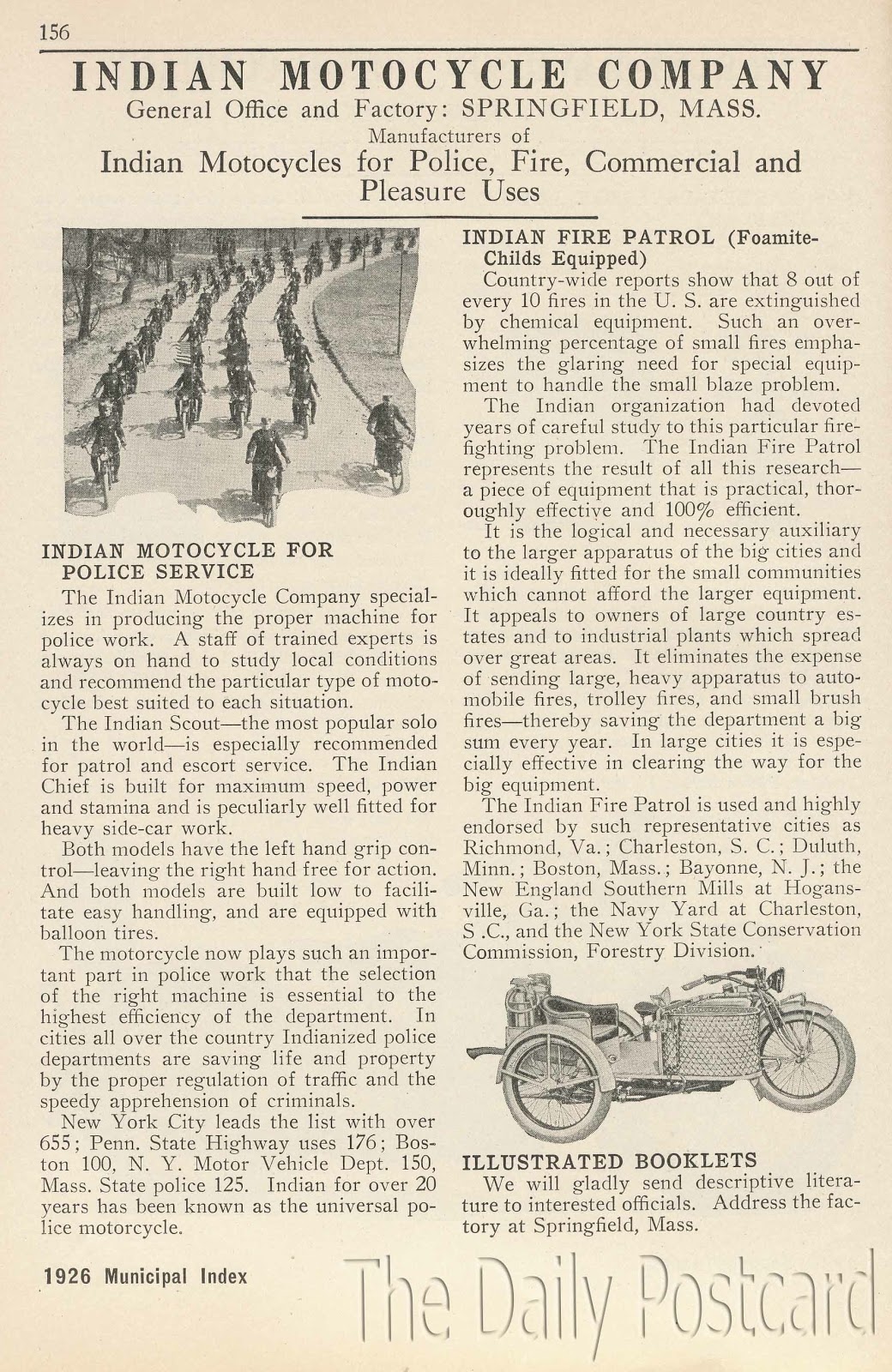
A slight detour from postcards today, because this book with the unassuming cover and title is absolutely fascinating. If you were a city, town, or county official, this is where you might look before ordering dump trucks, police motorcycles, voting booths, prison doors, parks and recreation equipment, and a host of other necessary items. I couldn't get very excited about the various rollers, crushers, graders, and mowers, but I think I'd like to order some Mack trucks. Hmmm, which one? They're all so multi-purpose.


Then I'd like to order some new motorcycles for our police force. I have a choice between Harley Davidson, Indian, and Henderson.


I guess I should buy some traffic signals too. There goes the municipal budget. Maybe I shouldn't have spent so much on those motorcycles.


Last, but not least, I'm going to order one of those new Junglegym contraptions. The kids seem to love them. In fact, C.W. Washburne, Superintendent of Public Schools in Winnetka, Illinois, has this to say:
"Retains its popularity after several years of use--Would sooner part with all the rest of our playground apparatus than with the Junglegym"
It turns out they never did get rid of it. The world's first Junglegym still stands at Crow Island School in Winnetka, Illinois.


Wednesday, August 8, 2012

Czech It Out

Here is a real-photo card of a woman wearing a traditional Czech costume. The picture dates from sometime between 1930 and 1950.


These next two appear to be from Uherské Hradiště, a center of Moravian Slovakia located in the Czech Republic near the border with Slovakia.


Both of these photos have interesting studio props. There are tassels on the furniture in the first one, but also on the chair in the second photo. The clock plant stand is also an unusual addition. The second photo appears to be a wedding portrait. Both photos have pushpin holes indicating that they were pinned up somewhere to be viewed as treasured memories.


Here are the backs of the cards in the same order. The last two cards have writing on the back. Alas, I don't speak Czech or Slovak, but I think the first one says Sister Marika and Franta's wife and the second one says something about my wife and I. If you can read this, feel free to correct.


Tuesday, August 7, 2012

Tram Tuesday - Schenectady, NY

Schenectady, New York had a streetcar system from 1886 until 1946. General Electric bought the streetcar company in 1896 and then set up a GE manufacturing plant in Schenectady. They then extended the streetcar loop to the GE plant to transport their 3,000+ employees to and from work.

There was also an electric interurban that brought people into Schenectady from the smaller towns of Gloversville, Johnstown, Amsterdam, and Scotia where they could then get on the New York Central train. Traveling glove salesmen from Gloversville used the trains to make their sales calls.

This view shows State Street and the Lorraine Block, demolished in the 1960s. The little building next to it may have been some kind of entertainment venue; there are two signs advertising Lew Dockstader, a Vaudeville entertainer. There's also a big sign for Stoll Famous Lager.


 The message on the front of the card, sent to Miss Lillian Wyckoff in 1907 reads:

I am having a dandy time. my address is 8 Romeyn Pl Schenectady N.Y. with this about the entertainment.
Your friend Nettie

Here's the back of the card.


Monday, August 6, 2012

Easy Sailing in Gelatt, PA

Once again we have cute Dutch stereotypes relaying greetings on an American card. These seem to have been particularly popular around 1910 in areas with strong Dutch heritage.
Gelatt, Pennsylvania is a 'populated place', not an official town.  I have a feeling it may have been more populated in 1915 when this card was sent. The postmark was from Gelatt, so we know they had a post office.


Mrs. B. Pickering sent this card to Miss Sarah Denney at Burns Hospital in Scranton, Pennsylvania.  I have other cards that Sarah Denney received at the hospital, but she appears to have recovered and lived to the age of 80. Sarah was born in 1895 and operated a grocery store in Union Dale, PA (current population 267). She died in 1975 and was buried in the Gelatt cemetery. It appears that she never married.


The message reads:

 from a Friend Mrs B Pickering
 glad your doing nicely.

It looks like Mrs. B Pickering, was Hattie Ball Pickering, first wife of Benjamin Butler Pickering. Hattie died in 1920 at the age of 48, whereupon Benjamin Butler married a woman by the name of Olive Warren. Benjamin and both of his wives are also buried in the Gelatt Cemetery. Here's a view of the cemetery from the road.


View Larger Map

Friday, August 3, 2012

Skandinaven's Book Department

John Anderson and his family made the journey from Voss, Norway to Chicago in 1844, when John was eight years old. His two brothers died on the trip, and his father died during a cholera epidemic in 1848. In order to make ends meet for his mother and infant sister, 12-year-old John sold apples and newspapers. His job as a newspaper boy led to additional newspaper jobs until finally he was working on layout for the Chicago Tribune.

In 1866, Anderson started publishing a Norwegian-language newspaper called the Skandinaven. It became America's leading Norwegian newspaper. Eventually, Anderson added a book store and a mail-order book department. Some of the longer works were published in installments. I wondered if that's what Hanna Jacobson of Astoria, Oregon had ordered. She received this card in 1904, acknowledging receipt of $13.50. I assumed that inst. stood for installment, but as the comments below reveal, it stands for instant, meaning this month.


Thirteen dollars was a lot of money in 1904.  I can hardly imagine what she must have been buying,  since Skandinaven's 1915-16 catalog offered books with gold lettering and engraved illustrations for a dollar a piece.

You can read lots more about John Anderson at the Norwegian-American Historical Association website in an article written by Jean Skogerboe Hansen.

Thursday, August 2, 2012

London - The Big Funny City in 1912

With traffic from the Olympics, it may have been easier to get around London in 1912 than it is today.  The first card is in fairly rough shape, but it includes a wonderful message written exactly 100 years ago today.


The message reads:

Chichester, Aug. 2' 1912
My Dear Alfred
I was much pleased today to find your kind note in my mail-bag! Thank you for remembering me.
I remember when your Father was about your age, that his grandmother took him to England. I have thought of it several times since I came here.
This card shows you one of the finest places in London. It is a big funny city. Do you see that two story omnibus?  with stair on the outside. It is one of the hundreds we see, and they are all covered over with posters advertising whiskey and beer, and soap and bread +c+c.
We are having a good time and seeing many fine things.
I hope you are all well. Give my love to your Father + Mother and all.  your Friend,
E.C. Harrington


Here are two more cards of the same era.


Wednesday, August 1, 2012

R.M.S. Berengaria

The R.M.S. Berengaria was originally built for the Hamburg-Amerika Line as the Imperator. At the end of World War I, she was seized by the America Navy and given to the British as reparation for sinking of the Lusitania. The ship was then sold to the Cunard line.


The Hall Genealogy website has lots of information on the ship along with many photos of the interior.

Tuesday, July 31, 2012

Tram Tuesday - Marseille, France

Back in 2011 I posted a colorful scene of streetcars on La Canebière in Marseille. Here are some more cards showing scenes of Marseille that include streetcars. The earliest trams in Marseille began service in 1876 and were pulled by horses.  As in most other places, the system slowly transitioned to electric power.  This first card, circa 1900,  appears to show horse-drawn and electric trams operating side by side.


Here's a close-up.


The tram system in Marseille has operated continuously, although the cars today are very sleek and modern in comparison to the ones shown here.


Monday, July 30, 2012

More Cats in Advertisiing

Here are some more cats working hard to promote totally unrelated products on circa 1880 trade cards. The first one is especially clever, suggesting that if you don't buy a shoe with a black reinforced tip, it won't even make a safe nest for birds.


If you're near Salina Street in Syracuse, new York, you can head over to G.W. Ingalls & Co. and buy yourself a pair.


Then you can head down the street and buys some fruit vinegar from John Ferguson, Grocer.


Friday, July 27, 2012

Cats in Advertising

Cats have been used to advertise everything imaginable, from shoes, to groceries, hardware, and medicine. Here are two trade cards from the 1880s featuring cats. The first one is an advertisement for Dr. Thomas Ecletric Oil, used all around the world and equally good for man and beast. If that's not enough, it was used for internally and externally for coughs, croup, asthma, diptheria, rheumatism, lame back, and a number of other things. The ingredients included spirits of turpentine, fish oil, oil of tar, and red thyme.


 The second card is equally peculiar. The picture , with a caption of Declaration of Love, seems to show a cat swatting a monkey...or is that a dog with a very long tail? In any case, one of them is chained to the wall.

 
If you think this is a strange approach to selling stoves and hardware, check out the back of the card.


Stay tuned for more cat advertising cards next week.

Thursday, July 26, 2012

City of Cleveland

Here is the Detroit and Cleveland Navigation Line's City of Cleveland by day and by night. The side wheel steamer was destroyed by fire shortly after it was built in 1907, but was rebuilt again by 1908. The Great Lakes steamer transported passengers between Detroit and Cleveland.


Here are the backs of the cards. I posted the second one first, because it has a message and some interesting cancellation stamps. The sender seems to have thought that a one cent was sufficient postage for a card from Detroit, Michigan to Mainz, Germany. It looks like it arrived postage due. I don't know enough about postal history though to be able to tell you why the amount stamped on it is 10 centimes instead of an amount in German pfennigs.


Here's the back of the first card.


Wednesday, July 25, 2012

Newgate Gap - Margate, England

Most of all I love postcards that show a snapshot of life as it was at that moment, people going about their business and perhaps stopping briefly to look at the camera. What happened just before the photo was taken? Did the man fall of the bike? Are the people on the iron bridge above watching this scene or looking out to sea? In any case, I would love to jump into the scene and take a walk to the refreshments shop, built into the rock face,  before I head down to the shore at Cliftonville, the coastal area of Margate, a town located in South East England.


This card shows the original bridge, built in 1861, a 42-foot span at an elevation of nearly 60 feet.  In 1907, a decision was made to replace the bridge with a new more ornate one.


Here's the back of the card. It's addressed to Mr. Chilvers, c/o Mrs Miles, Lower Lodge, Kingswood Manor, Burgh Heath near Epsom with a message that reads:

1 Princes St 
Margate
Dear Wilf
All right
Hope you are

Tuesday, July 24, 2012

Tram Tuesday - Salford, England

If you were standing here today in Salford near Manchester, you would be in the middle of the motorway. But back when this photo was taken, Cross Lane was a vibrant street with trams, shops, and the Ship Hotel and its famous Ship Pub. The Ship Hotel was built in 1888 and demolished in 1973 after many colorful years and many visits by foreign sailors and locals alike.


On this postcard you can see The Ship on the left-hand side. Jessie was staying just down the street from The Ship where you see the X.

At the time this postcard was published, circa 1910,  Greater Manchester had an extensive tram system. According to Wikipedia, the tram system provided 200 million passenger journeys per year by 1915 on 662 vehicles. At that time it was the most popular form of transportation. The tram system recovered quickly from damage during World War I, but was closed for a time in 1918 to stop the spread of the Spanish Flu.

In the 1940s,  tracks were pulled up to provide steel for the war effort. As in many places, the trend was to abandon trams for buses. Salford tram service ended in 1947, with Manchester service ending just two years later.

Here's the back of the card, with Jessie's message:

Dear Leon
Where I have put that cross is the place Street I am staying in I often ride on the street car to town lovingly Jessie

Does the fact that she refers to the street car instead of a tram indicate that she was perhaps visiting from the United States?


You can view a video of Salford history and The Ship at Salford Online.

LinkWithin

Related Posts with Thumbnails