Monday, September 3, 2012

Doing the Wash

I hope you're not celebrating Labor Day by doing laundry. If you are, at least you can take comfort in knowing how much easier it is today than it was at the turn of the century. And this lady thought she was fortunate to have a hand-cranked wringer.


Doing laundry isn't really newsworthy today, but I guess back in 1909 and 1912 it was a big enough job that it was worth writing home about.

These cards were sent in June and July, so I imagine the clothes were hung on the clothesline and came back smelling of sunshine. I hang laundry out in the summer too, but I would miss the convenience of a dryer in the winter.

The first card was sent to Mrs. Claude Light of Harpursville, New York in 1909. According to the 1910 Census, Claude (27) was a milk inspector for Borden Milk. His wife Nina, was 19 at the time.

The message reads:

We arrived home soon after eight. B.G. was surprised. Suppose you are canning. I washed today. I asked father how he was feeling today and he said he didn't know. Mother G. invited me up to dinner today. Write soon Lovingly M.


The second card was sent to Mr. Derrick Osro Steere of McDonough, New York in 1912. According to the 1880 Census, Derrick Steere, a dairy farmer,  was born in 1855. The sender, his daughter Nora, was born in 1879. The message (with very little punctuation) reads:

June 3, 1912
Hallo Father
I send this wishing you a happy birthday and many more to come we age well F' has got to Point I have washed I have got five turkeys is all when does yours come off I will write more and send to marrow so you will have all the news
your daughter Nora


Here are the other sides of the cards. Grace Lester must have had the first one glued in an album.


Saturday, September 1, 2012

A Range of Stoves

This week's Sepia Saturday prompt shows a country store interior with a pot-bellied stove. In addition to heating, people also used wood-fired stoves for cooking. Sometimes they were simple and other times they were extremely ornate.

Garland stoves have been around for a long time. In fact I remember considering one when I was shopping for ranges years ago. As far as I know, Garland only produces commercial ranges now.

This is one of my favorite advertising cards, although it's difficult to show with scanned images.
It starts out as a triangle like this.
 And then unfolds to find the children doing unspeakable things. The maid runs to alert their mother.


When she come back with the mother, the children are sweetly reading their books by the fire. But where is the cat?


In any case, it's an amazing stove. Not surprisingly, people still collect these even if they don't use them for heat. 

The Michigan Stove Co. had been making Garland stoves had been around since 1864, but they were originally unveiled at the 1893 World's Fair. In 1925 The Michigan Stove Co. merged with Detroit Stove Works, makers of "Jewel" Stoves and Ranges. Here's a trade card of theirs showing no stoves at all, but a blissed out girl on a shopping trip. She looks to me as if she's waiting for a train.


The Jewell stove name may be in quotation marks to distinguish it from another company, makers of the Jewett Range.


Sherman S. Jewett (1818-1897) was better known for his civic involvement and philanthropy than his stove business. You can read more about him here.

Be sure to check out Sepia Saturday this week, with many posts inspired by a single photograph.

Friday, August 31, 2012

Tuberculosis of the Head

Martha sent this card to her grandmother in May of 1909 from Davenport, New York. At that time her grandmother would have been 73 years old. When Fannie Utter was born in 1836, Andrew Jackson was president, the battle of the Alamo has just been fought, and there were 24 states in the United States. By the time Fannie died in 1915, she had lived through the Civil War, Lincoln's assassination, the invention of the telephone, the automobile, the airplane, moving pictures, and many other historic events. If she had only lived an additional 5 years, she would have been able to vote.


Fannie must have been delighted to get such a beautiful card, but the message probably had her deeply worried.

Dear Grandma
Thanks for the card you sent me I am feeling fine for me and working as hard as ever
Milo is sick again
The Dr. told him Monday he had symptoms of Tuberculosis of the head Wouldn't that be terrible if he has it
you must write a letter soon
from Martha


Oh, I do hope that Milo didn't have tuberculosis of the head. Tuberculosis was one of the leading causes of death at that time.

Thursday, August 30, 2012

Did You Really Say That?

This card shows a scruffy, ink-stained photo of L'arc de Triomphe in Paris, not worth posting if it weren't for the message on the back.


The message from Minnie to Seargeant Richard Davis, a patient at the U.S. Army Base Hospital #1  reads:

9-30-18
This arch is but 2 blocks from our hotel I do hope you will get to see Paris for it is a most beautiful city. Although I hate to admit it, I do think it is much prettier than New York. Hope you are still with us so I may see you again.
Sincerely Minnie


I'm afraid I don't know if Minnie was able to see him again or not.

Wednesday, August 29, 2012

René Bine - Kiss the Hand

Today we have another card from René Bine, sent to his sister Marie and parents back in San Francisco in November 1904. I have posted a number of other cards from René during his time studying medicine at the University of Vienna. I tend to focus on the messages written on these cards, but the cards themselves are also beautiful, and often include streetcars, such as the horse-drawn one on this card.


Here's a close-up of the tram with a Kodak advertisement on the back and a sign for a Zahnarzt (dentist) office on the corner.


The message on this card is a continuation from a previous card that I don't seem to have, although I do have a few others that express frustration with the cultural differences and bureaucracy in Vienna. This one, in which René recounts the comments of Professor Alois Monti, is particularly interesting though!

Every man of sense here laughs at their nonsensical customs. But the people, per se, are sensible. When a big chief comes in hospital, e.g. kids salute him by "Kiss the hand". When he leaves ditto. When sick kid is brought into clinic they do the act and as Professor Monti, one of the greatest kid specialists here says, "they spit the influenza bug, or slobber the germs of diphtheria on your hand + you rub them into your mustache the next minute!

But in spite of all Vienna peculiarities, for us it has its charms which we enjoy; its peculiarities make us fat from laughing at them, so thy too have their good features, you see.

Work continues as usual to be more than interesting and we manage to keep busy, though next month we intend to slacken our pace, to get at least 1 hour a day to read up things. Otherwise no news. regards to all the folks, 
kisses to you all,
Your loving brother and son,
René

Here's the back of the card.


If you're interested in reading more of René Bine's correspondence, go to the bottom of the webpage and click on the tag for Dr. René Bine.

Tuesday, August 28, 2012

Tram Tuesday - Durban, South Africa

Durban, South Africa had horse-drawn trams in 1880,  but converted to electricity in 1902. They had some fabulous-looking double-deck cars. In the mid-thirties, Durban started transitioning to trolleybuses, with the last electric trams running in 1949.  There is a great website with a section on the history of public transport in Durban written by Allan Jackson. In addition to a detailed history, he includes some very nice old photos of Durban's trams.


This card doesn't show a clear view of the tram itself, but it is a lively street scene. Here's a closer view of the tram.

The card was written in 1927, but the photo itself appears to be earlier, maybe 1910. At first glance I assumed the message was written in Afrikaans, but it isn't. My guess is that it's Danish, but I don't know for sure. Can anyone out there read this?

Here is a translation, courtesy of Helen in Denmark. Thanks Helen.

Septbr 4 - 1927
Dearest Gusta! 
You and the others are most welcome here for a small dinner this coming Saturday, the 8. of this month; can you be here between 6 pm and 6.30 pm, please not later; you know the way, don't you? Everything is fine with us - hope to see you, your husband, Beate and the two youngsters, I hope we can have a good time together. We have a dinner invitation today, so I will conclude with the warmest regards to you all from your [snuggling?] [a nickname referring to a child being put to bed possibly with a good night song] mother.

Monday, August 27, 2012

My Little Fat Girl

You can be sure that few 12-year-old girls would appreciate being called 'my little fat girl' as a term of endearment today, but back in 1911 it was probably received with a giggle. Maybe.

The lovely card was sent to Miss Fanny Irene Ely of New Milford, Pennsylvania (current population 868).


The message is very amusing:

Dear Irene.
How is my little fat girl now days, any way. I am sick I talked to much I guess (?)
Jaws hurt.
Yours -
L.M.L.


Irene was born in New Milford in 1899 to parents Charles and Jessie. Sadly, Irene's father, a laborer at the stone quarry,  died only a year after she received this card. Irene's mother remarried almost immediately, probably out of necessity, to a man named Hobert Gunn who was 12 years her junior and also worked at the quarry. Life must have been very tough in New Milford, because he died at the age of 39. Irene's mother outlived the second husband too, but died at the age of 57.

At that point it appears that Irene went to live with her sister's family, the Trowbridges, in the Johnson City/Binghamton, New York area, where she worked as a bookkeeper at the First National Bank. According to city directories, she was still working there in 1953. It doesn't look like Irene ever married though. After she died at the age of 58, she was buried with her parents in the New Milford cemetery.

Source

Friday, August 24, 2012

Bine - University of Vienna Medical School

René Bine is 22 as he writes his accounts of medical school in Vienna in 1904. He's full of observations on professors and fellow students as well as the cultural and political events of the day. 

Since Sigmund Freud was at the University of Vienna at the time, I am surprised that I have yet to come across any reference to him in René's cards. He does mention Alfred Fuchs though, who was also a professor of psychiatry and nervous diseases at the time. He also speaks of Dr. Edmund Neusser, another professor and, like René, an ardent music lover. In fact, Professor Neusser was himself a very accomplished pianist and married Paula Mark, a soprano with the Vienna Court Opera.

This is a picture of Professor Edmund Neusser.
Edmund Neusser
Source: Wikimedia Commons

Here's the card that René sent to his family back in San Francisco.
 

And here's what what he had to say:
 

Fuchs, the nerve man is popular as ever. Occasionally he hypnotizes a patient + thus livens up the otherwise quiet but most instructive and interesting demonstrations. Brother Eserich I have forgot to call on but 4 times this week as I preferred to favor Prof. Neusser for a change. Neusser gives lectures + demonstrations, but his voice is poor + hard to catch unless one be accustomed to it. He is to-day said to be the greatest diagnostician in Vienna, if not in the world, being chief over Kovack, ex-chief over Ortner, tho' for us Ortner seems as good. -
Nothing new otherwise. Everything is OK + I hope you can say ditto. Papa's foot I suppose is now a bobo long forgotten. Ma's cough, I know she does not want to lose, for without headaches she'd have no kick coming - Give my best regards to all the folks + receive best kisses from loving brother and son
René

You can read more about Dr. Norbert Ortner here. Of perhaps more interest is René 's reference to Brother Eserich, if as I believe, he is actually referring to Theodor Escherich, who was a professor at the University of Vienna at the time. It was Professor Escherich who discovered the bacterium Escherichia coli (also known as E. coli), which was named after him. He was also a very distinguished looking man.
Theodor Escherich
Source: Wikimedia Commons
This is one of many posts on the correspondence of Dr. René Bine of San Francisco. If you'd like to read more, go to the bottom of the web page and click on the tab for Dr. René Bine.

Here's the back of the card.

Thursday, August 23, 2012

Tiny Children of Normandy

Can these children possibly be this small? They seem out of scale with the rest of the picture. In fact they look to be about the size of a potted plant.


Here's a close-up.


Wednesday, August 22, 2012

René Bine - Two Sundays in Vienna

René Bine is studying medicine, but he's also interested in music and art so Vienna is a great place for him to be. His first-hand accounts are so detailed that you really get a sense of what it was like to be there. As always, the messages are written on the front of the card since the postal service did not allow messages to be written on the address side at that time. 

It's autumn 1904, and René has been out with good friends Tillman, Paul, and Hirschler. Paul and Hirschler were almost certainly classmates Paul Biber from UC Berkeley Medical School and Lee Hirschler from the University of Virginia Medical School, but I'm not sure who Tillman was.

Sunday evening Tillman, Hirschler, Paul + I sat in the Volksgarten from 9:15 11:30 drinking beer + listening to one of Vienna's best orchestras. It is a very nice resort, in Louvre style but larger. Many eat dinner there for the music starts 4 P.M. + it is wonderful how people begin to go home at 10 P.M. (music stops 11:30)

Sunday afternoon from 5 to 6:30 we witnessed a great socialist demonstration against the Mayor who elected by them proved traitor to the Socialists. Celebrated his 60th birthday, but to carry out the proceedings the Rathouse (city hall) had to be walled off by police to keep the crowd away. No one would come within 2 blocks of " + over 1500 Police were on duty there. Crowd were only once in danger of charging + were easily quelled.

Note: The mayor that René Bine refers to was Karl Lueger, founder of the Christian Socialist Party, and a man known for his anti-semitic rhetoric. 


The second card is from another Sunday concert at a different location a week or two later.

Sunday afternoon we went to the Ronacher Café [not Ronacher Theater] + there listened to about 3 1/2 hours to music performed by Johannes Müller + orchestra. Strauss, whom we heard last Sunday, may be a greater man, but I prefer Müller's band. I am perhaps prejudiced by the fact that Ronacher Café is but 1/2 the size of Sophie Saal therefore more cozy, warmer + the music reaches all parts. Everybody sips coffee, chocolate or beer but the audience is most quiet during the time the orchestra plays. We enjoyed it so we forgot all about dinner till 8 P.M.. We then went + found a very fine restaurant "Kellerei zum St. Stephan" + I tell you we enjoyed a good dinner, Tillie, Paul, Hirschler + I. We were all at home at 10.

The message continues with the beginning of a sentence: "Hirschler...", but I don't think I have that next card.


There are more though. The adventures of  Dr. Bine continue on Friday.
To read some of the previous Dr. Bine posts, click here.

Tuesday, August 21, 2012

Tram Tuesday - Swansea, Wales

Along with the tram, this card has some great little details of High Street in Swansea including the shops of Richard Lewis, Milliner, and Jack Lewis (his brother?), as well as the Royal Hotel.


We can also see the sign for Myrddin Davies, Cash Chemist. It also appears that there is a bit of horse manure on the right side of the road.

Perhaps the young girl is shielding her nose from the smell.

Swansea has horse trams in 1878. Steam-powered trams were used briefly before the switch was made to electric traction in 1900, however the street tram system was closed in preference to buses in 1937. Recently there has been talk of reintroducing trams in Swansea. There have also been efforts to refurbish High Street and encourage mixed use developments. High Street today looks nothing like the picture above since the buildings surrounding High Street were destroyed by German bombs in World War II.

Here's the back of the card, sent to Mrs. C.E. Potter of Potter, Kansas in 1926, with the following message:

7-31-26
This from the ____ lady on the train returning from ______.
We had a most delightful voyage across - seven days on the ocean blue - It was grand -Will be traveling to Scotland + France before we return Sept 25th date of returning sail.
Fraternally - Mrs Evan Davis
Topeka


The recipient of the card was likely Charlotte Estelle Potter.
It's worth noting that the post office in Potter, Kansas opened in 1865. It was threatened with closure back in the 1970s, but didn't actually close until 2009. In 1976, Wendall Anschutz filmed a travelogue piece on Potter and its post office.

Monday, August 20, 2012

Pointing the Finger in Washington

You immediately thought of Washington, D.C. when you read the title of the post, didn't you? It's exactly this reaction that gives Washington State a complex. Natives always have to emphasize Washington STATE when they say where they're from. And until Seattle became a big deal, no one really gave much thought to Washington. But I can just imagine the brainstorming session at the Washington State Advertising Commission decades ago when they determined that postcards should be produced to showcase the beauty of Washington State and entice people to visit.

The commissioners all agreed that the postcards were a good idea, but some were worried that  people might be unable to identify the scenic attractions in the photos. After all, people from other states might not recognize nature when they saw it. The group then discussed superimposing big red arrows on the cards to highlight the Columbia River and surrounding scenic vistas, but after much brainstorming they decided that human subjects pointing at the scenic attractions would be equally effective and much more subtle. Brilliant.


Since marketing people know all about human preferences though, they also realized that some people just don't like nature all that much. Trees, water - so what! What could they do to attract the urban nature haters? They considered adding a bunch of girls in bikinis or a stock photo of a woman eating asparagus, a popular local crop. But since they were also trying to be family friendly, they all agreed that a young woman leaning on a car was a much better choice and something that both men and women could relate to.


These cards make me want to go to Washington and lean on a car right now!


Friday, August 17, 2012

René Bine Visits the Vienna Opera

The young René Bine of San Francisco appears to have been very enthusiastic and dedicated to his study of medicine in Vienna in 1905, but not so dedicated that he couldn't find time to enjoy the sights and sounds of the great city.  If you happen to be an opera history buff, this firsthand account of the opera performances should be especially interesting. If not, you may just enjoy the pattern of his tiny and meticulous handwriting and be glad you don't have to decipher it.

René was 23 at the time and regularly sent cards addressed to his sister Marie, one year his junior, but with news intended for his parents as well. Last week, I suggested that René's father might also have been a doctor. That turns out not to be true. Leon Bine, an immigrant from Châtenois, France, was a cloth merchant who worked for Reiss Bros. & Co. in San Francisco, before opening his own business, Bine & Co. sometime before 1908.

Here's card #204, sent from Vienna.


The message reads:

Dear folks. Friday evening we all went to see Tannhäuser which afforded us a most enjoyable evening + now I realize how superior to Frisco is the Wiener opera. Before all I will admit that the singers i.e. the stars do not compare favorably with Grau's collection, but the tout ensemble is what counts. And further Tannhäuser affords an opportunity for beautiful scenic effects + magic-like stage transformations of which I little dreamed. 

And I must add that having seen quite a few operas since I'm in Wien (including Lakme Queen of Sheba, Hoffman's Erzählungen, die Fledermaus, La Bohème, Norma, Freischütz, Lohengrin) I Prefer the following in about this order Tannhäuser, Pagliacci, Cavalleria Rusticana, though for all I'm told, I believe I will modify this opinion ere long + put Fidelio at the head of the list. To-night, Saturday Paul + Tillie are seeing Pagliacci+ C.R., while I'm taking it easy at home. This A.M. as  is my wont I was at 8:15 at Ortner's. It is a bit cold + dark mornings + out of the whole crowd of Americans who usually come, we were only 4 to-day + the less present, the...

I have a card #205, but it doesn't seem to be a continuation of this one. The system is confusing. Let's move on to card #206.


Monday Jan. 23. 05.
Went to Fidelio last P.M. + it was the most enthusiastic audience I've ever found myself in. The tenor, Winkelman, Wien's old tenor had but little do to (?), + with his usual ready-to-bawl voice did it well. Lilly Lehman was at her best. She is no spring chicken, this once beautiful Lilly, + is retired from the opera to stage, but Adeline-wise now + then comes out of her beautiful suburban residence to sway the hearts of her fellow citizens with her melodious voice. As an opera I cannot give Fidelio 1st place in my list. The ouverture to the last scene, as far as my personal opinion goes, is far + above any other music in the whole piece. The cast was about the strongest the opera boasts of it, + it was also beautifully staged. - Tonight we go to the Rhinegold. Prague's best tenor will shine as guest. Some new stunts have been performed with the piece + they shall play it 4 times this week so great has been the demand. Paul + Tillman were down early yesterday + procured...

I'm afraid we'll never know what they procured.  I'll post more of René Bine's adventures and observations as soon as my eyeballs recover. Although I don't know who Tillman was, Paul is presumably Dr. Paul E. Biber, a classmate of Dr. Bine's.

Here's the back of the first card.


Thursday, August 16, 2012

Pocatello, Idaho

The City of Pocatello, named after Chief Pocatello of the Shoshone tribe, was an important trading post, a stop on the Oregon Trail, and a gold-rush destination. Later, ranchers and farmers started settling there and it became a real town. It now has a population of over 54,000, but this brightly-colored linen card is from the 1940s when an entire phone number consisted of only 3 digits (671.)


Wednesday, August 15, 2012

Bine and Friends in Vienna

It's 1904 and our studious friend, René Bine, is enjoying the experience of studying medicine abroad. I have postcards from 1904, 1905, and 1907, so I wondered where he was during the 1906 earthquake. It turns out he was back in San Francisco for the cataclysmic event. In fact there are so many records, including passport applications, that it's pretty easy to find out where he was at any given time. More to come on that, of course. In the meantime, here he is living it up in Vienna in October, 1904.


The message on card  #112 reads:

Thursday, October 6, 1904
Dear Folks,
I believe to-day is mail day, but no news is there to be had in spite of that fact. The same old monotonous facts prevail. We arise at 7 or 7:15 A.M. + after breakfast usually accompanied by umbrellas walk our 1/2 or a bit less to our Krankenhaus (hospital). Umbrellas, I emphasize, for it rains 3 mornings out of every 4, + on the 4th it is sure to be raining by noon, + on the other 3 days it usually stops sometime after 1 or 2 P.M. so that we can very accurately prophesy the weather here. - Then at 1:15 we come home, + 1:30 we eat. We have at our table, our Mt. Sinai friend, Dr. Hirschler, a Boston man Conlan who weighs 180 and is about 5 ft. 5 in., besides a lawyer from Vienna named Unger, a Dr. West from N.Y.  etc etc but we enjoy most our man Conlan. He has an appetite that

(continued on next card)


does not beat mine, but he insists on taking all on his plate at once + yells Schnell at the girl (1 of his few German words) + withall is so serious that Paul and I roar even before his comical fat face - Then we have our Chicago Leschititzkyarian + a pretty sister, + we joshed them aided by Conlan so that they never know when we're serious. they are lots of fun. One is Unitarian, the other Presbyterian; their name Trumbell, one says is Scotch, + the other she says nay, + when one wished to throw something at me, the 2nd she held her arm - yes, the latter is the nicer of the two. On our off nights we get the pianist to spring a few Symphonies on us. She is really clever.

Say, when you write me more than 4 sides of letter paper, remember Jules has to pay 10 cents and I 10 cents here. So either weigh after.. or use much thinner paper + envelopes. Rec'd yours of 8th + 14th (Marie's) 2 days ago, ___'s Paris, none from anybody else. Even my wives don't write. I guess the new men have cut us out. Paul gets us the news however from here and home both.

Have you ever seen anyone write so much on a postcard? As for wives, he wasn't married yet, that was still several years off.

Here's the back of one of them; at that time no messages were allowed on the address side.


More to come...

Tuesday, August 14, 2012

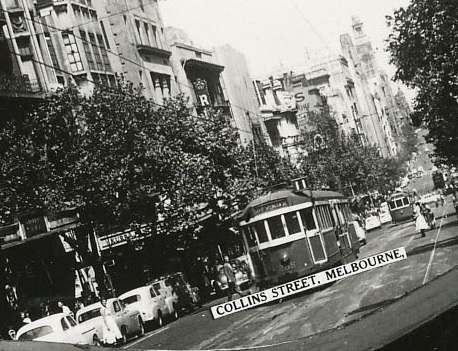
Tram Tuesday - Melbourne, Australia

I was surprised to learn that  Melbourne, Australia has the largest tram network in the world. That's right, larger than St. Petersburg or Berlin, with 250 km of track, 487 trams, and 30 routes. The tram system in Melbourne has been around since 1884 and currently provides over 182 million passenger trips per year.

In contrast to many places that had mostly horse-drawn trams in the early years, Melbourne focused on a cable-drawn system before changing completely to electricity in 1940.

There is no message on the back of the card, but here's a close-up.


Monday, August 13, 2012

René Bine #110

This is a continuation of the message from card #109 on Friday's post.  Dr. René Bine wrote messages that continued mid-sentence from one card to the next. It's a shame about the occasional missing cards, but I do have this one.

Here's a link to the previous post, if you didn't read that message. This is a beautiful card with a lot of detail, even without the descriptive message, and Bine is fairly careful about keeping his writing to the blank spaces.


The message continues from the previous card:
We also are figuring on entering university courses from 8 to 9 A.M. + 12 to 1 PM or 5 to 6:30 so you can see we will have more then we would the latter are...

practically "free" the other "pay" courses limited to 10 men + we are well satisfied with our success so far. I never kick any how as I have all I can do to study the lingo.
We heard indirectly of the severe accident which befell Miss Mabel Brunker, our U.C. M.D. librarian + a very good friend of ours. If you hear or read anything about its significance (maybe fatal) let me know. Also as I said before leaving, send me only the Sunday Bulletin "News" part + if evenings occasionally then be topics of local interest, only the "news" sheets. We see here the Neue Freie Presse - Wien + every other day or so, at the Cafe, the Paris N.Y. Herald + London Times.
Universitat Strasse is the continuation of Alser Strasse + is running in the picture, toward the Ring. University is 3 blocks from the Krankenhaus (hospital) which faces Alser Strasse. we are 2 1/2 blocks from the latter.

As far as I can tell,  Miss Brunker recovered and lived many more years. More to come on Wednesday.

LinkWithin

Related Posts with Thumbnails